Netflix’s Microservices Architecture: How a Tech Giant Scales Worldwide Streaming at Lightning Speed
Netflix’s Microservices Architecture: How a Tech Giant Scales Worldwide Streaming at Lightning Speed
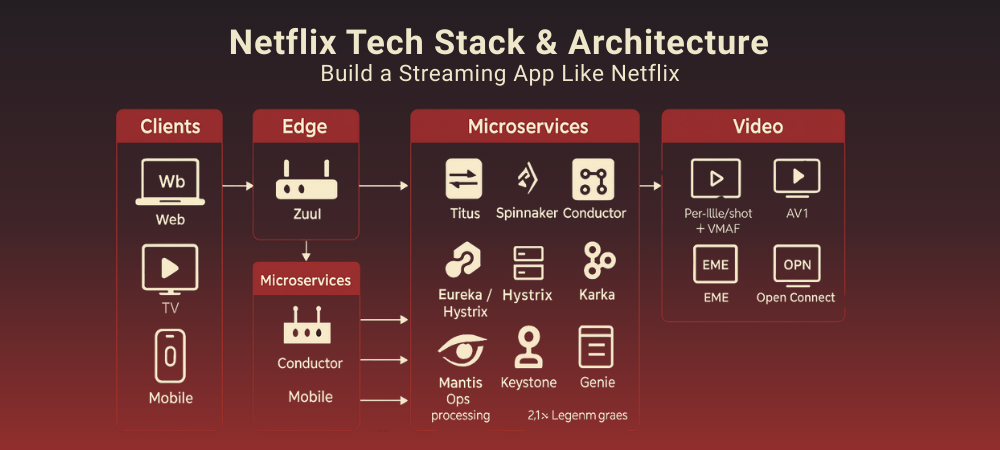
Behind every seamless scene of your favorite Netflix show lies a staggeringly complex technological backbone—one that powers real-time streaming across 190+ countries, supports millions of concurrent users, and handles variable demand with unmatched reliability. At the core of this transformation is Netflix’s pioneering microservices architecture, a technical masterpiece that redefined how large-scale web platforms are designed, deployed, and maintained. This deep dive reveals how Netflix decomposed its monolithic past into hundreds of independent, API-driven services, enabling unparalleled agility, scalability, and resilience in one of the world’s most demanding digital environments.
At its foundation, microservices architecture represents a deliberate shift from monolithic systems—where all components run as a single unit—to a modular framework composed of loosely coupled, independently deployable services. Each service encapsulates a specific business capability: user authentication, content recommendation, episode streaming, billing, or metadata management. “We used to think of Netflix as a single massive system,” explains a former Netflix engineering leader.
“But in reality, we’re a collection of hundreds—yes, hundreds—of small, focused services. Each one can evolve, scale, and fail independently without bringing down the entire platform.” This architectural choice solved critical bottlenecks endemic to monolithic designs. In traditional systems, updating one feature risked destabilizing unrelated functions, slowing release cycles, and amplifying failure impact.
By contrast, Netflix’s microservices allow teams to deploy changes in minutes rather than weeks, experiment boldly, and maintain high availability. Each service operates within its own technology stack, enabling engineers to pick optimal languages and databases—Python, Go, Java, Cassandra, DynamoDB—based on performance needs.
Scalability is not just a feature of Netflix’s microservices—it is a default state.
Just-in-time scaling ensures that during peak hours, specific services like streaming and video rendering modules can dynamically expand capacity. “When millions tune in simultaneously to a new season, we don’t risk crashing; we just spin up more instances of the services under load,” said an architect involved in the architecture’s design. Leveraging cloud-native tools, Kubernetes orchestrates containerized deployments, while API gateways manage traffic efficiently.
This elasticity transforms unpredictable demand into an optimized user experience, free from the latency or downtime that plagued earlier streaming platforms. Data management further underscores the sophistication of Netflix’s service decomposition. User preferences, metadata, viewing history, and recommendation logic are distributed across dedicated services, synchronizing via asynchronous messaging and event-driven APIs.
For instance, recommendation engines feed insights back to content discovery services in near real-time, creating a feedback loop that personalizes every viewer’s experience. “Every service owns its data responsibility,” notes a senior backend engineer. “This keeps data consistency strong while enabling autonomous service evolution—without tight coupling.” Fault isolation is another key advantage.
In monolithic systems, a single bug could cascade into widespread outages, but with microservices, failures are contained. Netflix’s observability stack—including tools like Atlas for monitoring and Custom Logging—tracks thousands of service interactions, flagging anomalies instantly. Automated circuit breakers and chaos engineering practices ensure resilience, meaning when one service fails, others continue operating seamlessly.
“We’re built to fail fast and recover faster,” one developer put it bluntly. Yet, this technical elegance emerged from a cultural transformation. Breaking down systems into microservices demanded more than code changes; it required cross-functional teams to own entire service lifecycles—from development to deployment and monitoring.
Netflix embraced DevOps and Agile principles deeply, enabling engineers to release updates autonomously. “Ownership breeds accountability,” said an early architect. “When teams control their services end-to-end, innovation accelerates.” Performance-Enabling Technologies in the Microservices Ecosystem
Netflix’s microservices architecture gains power from targeted use of high-performance technologies carefully selected for specific roles.
Streaming quality hinges on content delivery services that integrate with adaptive bitrate streaming protocols—HLS and DASH—delivering smooth playback across devices. Behind the scenes, HTTP/2 and QUIC protocols minimize latency and reduce download overhead, ensuring video content loads predictably even on constrained networks. At the edge, massive global CDNs cache and serve content efficiently, while content encoding services dynamically generate optimized video versions for different screen sizes and bandwidths.
Caching strategies play a vital role. Frequently accessed metadata, thumbnails, and recommendation data are stored in high-speed caches—Redis and Memcached—reducing database load and accelerating response times. For stateful interactions, sessions and tokens are managed efficiently through distributed caching, avoiding single points of bottleneck.
Moreover, asynchronous communication via message brokers like Kafka decouples dependent services, enabling high throughput and reliable event processing without blocking. Decentralized Teams: Guilds, Platforms, and Shared Responsibility
Structural innovation complements technical design. Netflix segments its workforce into agile guilds—cross-disciplinary teams focused on specific platform layers like security, streaming, or personalization—empowering engineers to collaborate deeply around shared goals. Each service is


Related Post

Where Grief Finds Quiet Respect: The Legacy of Ponders Funeral Home in Calhoun

From Small Starts to Olympic Dominance: Michael Phelps’ Groundbreaking First Olympics in Sydney 2000

Where Is Michael Vick From? Tracing the Roots of a Pro Football Icon

Sabalenka vs Gauff: A Clash of Generational Tennis Titans Dominating the Court


