How to Tell If a Molecule Is Polar or Nonpolar: The Silent Force Shaping Chemistry
How to Tell If a Molecule Is Polar or Nonpolar: The Silent Force Shaping Chemistry
Molecules lie at the very heart of chemistry, and their polarity—or lack thereof—dictates behavior in everything from water’s extraordinary properties to the function of DNA. Yet identifying whether a molecule is polar or nonpolar often remains a challenge, even for students and scientists alike. The distinction hinges on subtle electron distributions and molecular geometry, but clear tools and criteria exist.
By analyzing electronegativity differences, molecular symmetry, and vectorial charge poles, one can precisely determine polarity—and gain insight into solubility, reactivity, and intermolecular interactions. Understanding how to distinguish between polar and nonpolar molecules unlocks a deeper grasp of chemical phenomena that shape both nature and technology.
At the core of molecular polarity lies electronegativity—the tendency of an atom to attract shared electrons in a chemical bond.
When two atoms differ significantly in electronegativity, electrons shift unevenly, creating a dipole: one end positive, the other negative. For instance, in hydrogen chloride (HCl), chlorine’s high electronegativity draws electron density toward itself, resulting in a polar bond. But whether the entire molecule is polar depends not only on bond polarity but also on geometry.
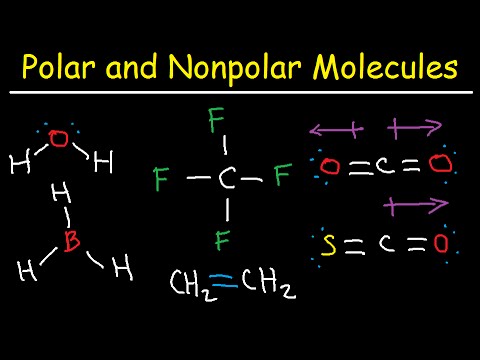
The more symmetrical a molecule, the more likely bond dipoles cancel out. Carbon dioxide (CO₂), though composed of polar C=O bonds, is nonpolar overall because its linear shape symmetrically distributes electron density. This balance between bond polarity and molecular shape defines polarity with precision.
Key Factors in Identifying Polarity
To determine if a molecule is polar, three critical factors must be examined: electronegativity differentials, molecular geometry, and symmetry.
Each plays a decisive role in shaping dipole moments and overall molecule behavior.
Electronegativity and Bond Polarity
Electronegativity differences create polar covalent bonds, but polarity extends beyond individual bonds. Atoms like oxygen (3.44) and nitrogen (3.04) form polar bonds with hydrogen (2.20), while halogens show varying effects depending on their position in the periodic table.
When electronegativity differences exceed 0.4, bonds are strongly polar. For example, in NH₃, the N-H bonds are polar, but due to the molecule’s trigonal pyramidal geometry, the dipoles do not fully cancel, resulting in a net molecular dipole. In contrast, BF₃, with its trigonal planar structure, has symmetrically opposed dipoles that fully offset, yielding a nonpolar molecule despite polar bonds.
This principle underscores that polarity emerges from both bond character and spatial arrangement.
Molecular Geometry and Symmetry
Even with polar bonds, symmetry determines polarity. A molecule’s shape—dictated by electron pair repulsion (VSEPR theory)—dictates whether individual bond dipoles cancel.
Methane (CH₄), for instance, is polar on a per-bond basis yet nonpolar overall due to its tetrahedral symmetry, where dipoles cancel vectorially. Water (H₂O), with its bent geometry, has unequal bond angles and no symmetric cancellation, producing a net dipole. Similarly, sulfur tetrafluoride (SF₄) features a see-saw geometry with lone pairs distorting symmetry, rendering the molecule polar.
Thus, symmetry is the decisive architect of molecular polarity, overriding bond polarity when geometry dictates imbalance.
Bond geometry and symmetry principles unify diverse systems into coherent categories. A molecule shaped by symmetry cancels polarity; one lacking symmetry preserves it.
Observing shape through molecular models or computational tools translates into predictive polarity assessments.
Practical Methods for Polarity Analysis
While theoretical understanding provides a foundation, practical approaches validate polarity. Polarimeter measurements directly quantify optical activity, useful for chiral or strongly polar compounds like amino acids. Dipole moment experiments, though advanced, measure the vector sum of bond dipoles—most commonly via microwave spectroscopy or theoretical quantum calculations.
Equally effective is molecular modeling using software such as Gaussian or ChemDraw, which simulate electron density and quantify dipole vectors. These tools reveal polarity with precision, bridging theory and real-world behavior. Alternatively, empirical rules offer quick assessments.
The “like dissolves like” principle strongly hints at polarity: highly polar molecules like ethanol dissolve in water, while nonpolar hydrocarbons like hexane remain immiscible. This practical validation complements analytical methods, making polarity more accessible across disciplines.
Examples and Case Studies
Consider polar versus nonpolar paradigms.
Sodium chloride (NaCl), an ionic lattice with maximum electronegativity contrast, forms ionic crystals with strong, nonpolar-like bulk behavior—yet individual ionic dipoles are undeniably polar. In contrast, methane (CH₄) is uniformly nonpolar, limited by nonpolar covalent bonds and tetrahedral symmetry. Water (H₂O) exemplifies polarity’s profound impact: its strong dipole enables hydrogen bonding, influencing boiling point and biological function.
Ammonia (NH₃), polar yet less so than water, shows similar hydrogen-bonding capacity. These contrasts highlight how polarity governs phase behavior and reactivity.
Hydrogen peroxide (H₂O₂), despite two bond-polarized O-H bonds, remains nonpolar due to its disymmetric structure and absence of net molecular dipole.
In contrast, carbon tetrachloride (CCl₄) is polar overall even though C-Cl bonds are symmetrically oriented—because electronegativity differences create lasting dipoles. These nuances underscore that symmetry—not just bond type—dictates molecular identity.
The Role of Polarity in Real-World Applications
Understanding molecular polarity is critical across industries.
In pharmaceuticals, polarity guides drug solubility and cell membrane permeability: polar drugs often dissolve better in aqueous environments but struggle with lipid barriers, while nonpolar compounds penetrate membranes more readily but may lack bioavailability. In environmental science, polar pollutants like certain pesticides dissolve in water, spreading through ecosystems, whereas nonpolar contaminants like PCBs accumulate in fats. Materials science leverages polarity in designing polymers, coatings, and adhesives with tailored surface interactions.
From healthcare to environmental policy, mastery of polarity enables smarter, safer, and more effective innovations.
Even nanotechnology exploits polarity: surface functionalization uses polar groups to enhance reactivity or selectivity. Thus, identifying polarity is not merely academic—it directly influences molecular design and application.
Polarity is far more than a molecule’s charge distribution; it governs interactions at every scale, from molecular recognition to planetary systems. By combining electronegativity principles, symmetry analysis, and modern measurement tools, scientists and students alike unlock the silent game of dipoles shaping chemistry’s most vital processes. Mastery of this distinction transforms understanding—turning abstract theory into practical insight that drives discovery and innovation.


Related Post

Who Is Colin Farrell’s Wife? The Private Life of Ireland’s Star Turned Family Man

Minecraft 1.20.1 Mods: Unleash a Whole New Dimension of Gameplay

The Longest Ride: Unveiling the Real-Life Romance That Inspired a Timeless Story

Married With Children: Unmasking the Cast Behind the Iconic Dynasty of DivDas & Dale


